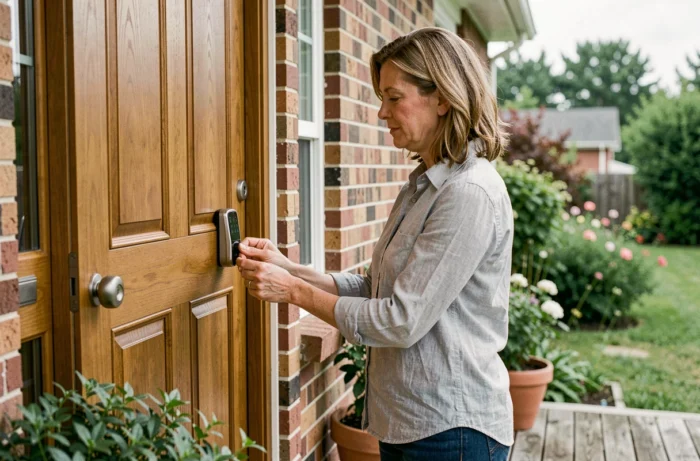
Transforming and securing a home relies on technical choices that vary according to the type of targeted threat: burglary, fire, domestic falls, or thermal discomfort. Each aspect involves distinct equipment, with measurable differences in cost and effectiveness. Comparing these solutions allows for the identification of those that deserve priority investment.
Comparison of protection solutions by type of domestic risk
| Type of risk | Main solution | Level of protection | Installation complexity |
|---|---|---|---|
| Burglaries (doors) | Certified armored door + 3 to 7 point lock | High | Professional intervention |
| Burglaries (windows) | Anti-burglary glazing + roller shutters | Medium to high | Specialized installation |
| External intrusion | Motion detectors + surveillance cameras | High (deterrence + alert) | Modular (wired or wireless) |
| Fire | Smoke detectors (DAAF) | Mandatory (legal minimum) | Self-installation |
| Falls (seniors) | Grab bars + enhanced lighting | Medium | Simple to moderate installation |
| Summer overheating | Solar protections + insulation | Variable depending on the building | Renovation possible |
This table highlights a often overlooked point: domestic security covers at least four distinct families of risks. Competitors mainly address anti-intrusion, while fire prevention and adaptation to aging respond to specific regulatory obligations.
To delve deeper into the various categories of work and equipment related to housing, it is useful to learn everything about Sklunk before defining priorities.
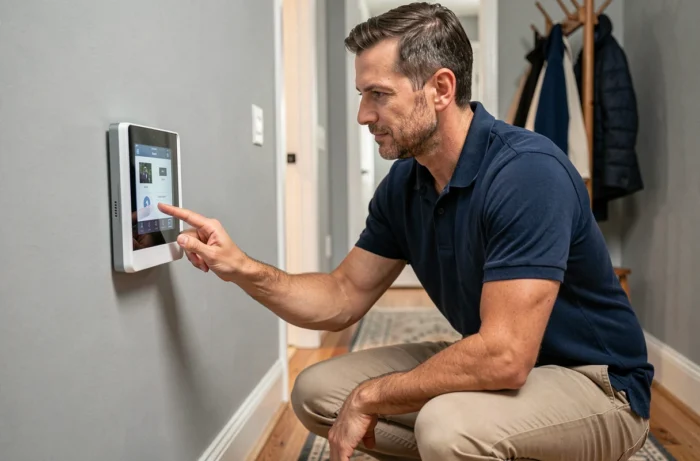
Smoke detectors: the gap between minimum compliance and actual coverage
Regulations require one smoke detector per dwelling. One device is enough to be compliant. In a multi-level house or with distant rooms, this minimum compliance leaves areas uncovered.
A detector installed in a ground floor hallway does not detect a fire starting in a bedroom upstairs. Practical recommendations suggest placing one on each level, or even one per sleeping area.
Tenant or owner responsibility
The initial installation of the DAAF is the owner’s responsibility. Ongoing maintenance (monthly testing, battery replacement) falls to the tenant. In co-ownership, each unit must have its own detector: common areas do not cover this obligation.
A compliant dwelling is not necessarily a well-protected dwelling against fire. The difference lies in the number of devices and their positioning.
Home alarm and surveillance system: the criteria that separate offers
The domestic alarm market offers systems ranging from standalone kits to remote monitoring with intervention. The differences lie in three technical variables:
- Connectivity: a wired system remains operational in case of a Wi-Fi outage, while a wireless kit is easily movable and installs without construction work.
- Remote monitoring: a monthly subscription triggers the dispatch of an agent or a call to law enforcement in case of a confirmed alert. Without a subscription, notifications go to the owner’s smartphone, who manages the situation alone.
- NF and A2P certification: these labels guarantee the equipment’s resistance to tampering attempts. Some insurers condition theft coverage on the presence of a certified system.
Outdoor surveillance cameras complement the system. A motion detector coupled with a camera reduces false alerts compared to an isolated sensor. Night vision and image storage (local or cloud) are parameters to check before purchase.

Adapting housing for aging: a project distinct from anti-intrusion security
Fall prevention at home concerns an estimated 2.3 million homes to be adapted by 2033, according to an October 2026 publication. The targeted works (grab bars, removal of thresholds, lighting of pathways) have nothing to do with alarms or locks.
The MaPrimeAdapt’ scheme, intended to finance these adaptations, experienced a suspension in early 2026 before reopening on February 23. This instability complicates the planning of works for affected households.
Concrete measures to prioritize
Securing electrical cables to the wall, removing non-slip rugs, and installing switches accessible from the bed are low-cost interventions. Grab bars in the bathroom and the installation of non-slip flooring require a moderate budget but significantly reduce the risk of fractures.
Staying at home depends as much on interior design as on protection against external threats.
Doors, windows, and external access: prioritizing weak points
The majority of break-ins occur through the front door or ground floor windows. Strengthening these two access points covers the main share of the risk.
A certified armored door, combined with a multi-point lock (3, 5, or 7 points), serves as the first line of defense. Windows benefit from burglary-resistant glazing and lockable roller shutters. The garden also plays a role: overly dense vegetation near openings provides cover for intruders.
Trimming vegetation around windows reduces concealed approach areas. Outdoor lighting with motion detection complements this passive deterrent strategy, without subscription costs.
Simulating presence during a prolonged absence (programming lights, notifying a trusted neighbor) remains an effective reflex that requires no heavy material investment.
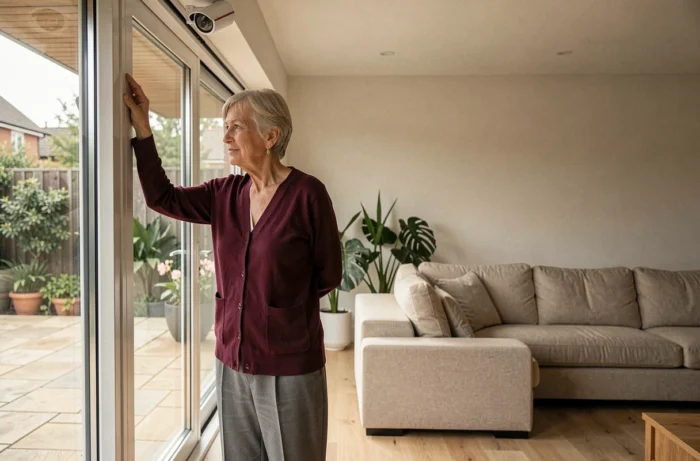
The security of a home is not limited to a single piece of equipment. Data shows that each type of risk (intrusion, fire, fall, overheating) requires different technical responses. The most cost-effective measure remains strengthening the main access points, complemented by an appropriate number of smoke detectors relative to the actual area of the dwelling.