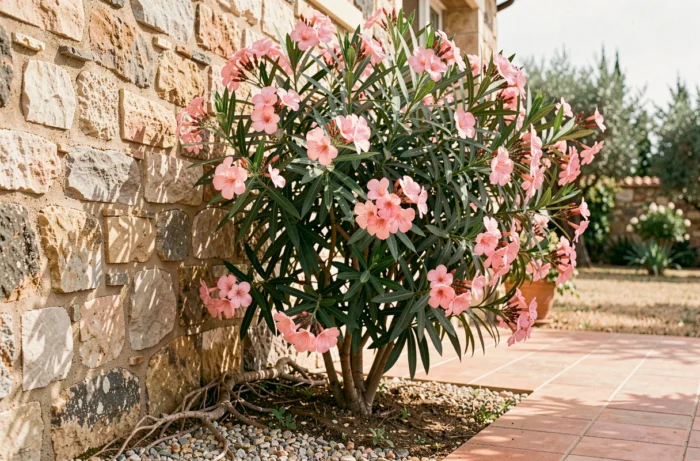
The oleander (Nerium oleander) develops a fibrous, dense but shallow root system, which does not produce a destructive taproot comparable to that of a plane tree or a fig tree. Therefore, the question of the distance to the wall cannot be reduced to a single number: it depends on the type of soil, the condition of buried networks, and the nature of the foundations.
Clay shrink-swell and oleander: the underestimated factor
On stable soil (sandy, loamy, draining limestone), planting an oleander near a wall presents a low structural risk. The situation changes on clay sensitive to shrink-swell.
A dense mass of oleanders continuously extracts water during the warm season. On clay soil, this consumption exacerbates local drying and can trigger differential settlement at the base of the foundations. The type of soil weighs more than the raw distance to the wall: we recommend checking the parcel exposure on the official Géorisques map, searchable by address, before making any location choice.
In areas of medium or high exposure, plan for a setback greater than the expected adult height of the shrub. If this setback is impossible, container cultivation protects the foundations without compromise.
When studying the roots of the oleander and wall distance, this soil diagnosis should always precede the planting decision.
Pipes and degraded joints: the real mechanism of root intrusion
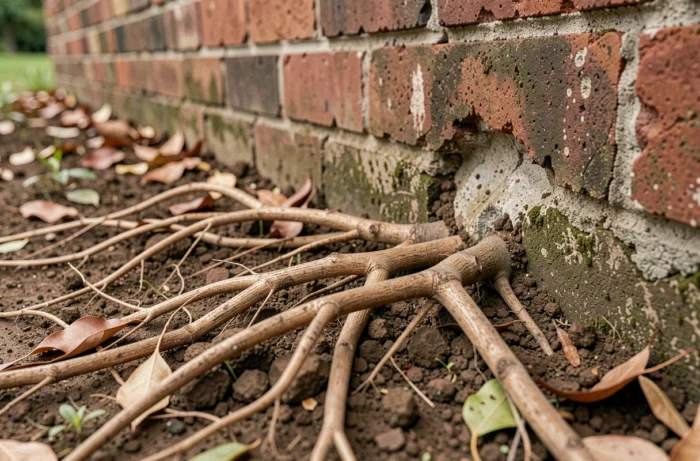
Oleander roots do not penetrate a healthy pipe, whether it is properly glued PVC or new cast iron. They exploit an already failing network: micro-leak on a rough joint, aged rubber seal, crack on an old pipe.
Even minimal infiltration is enough to guide the rootlets by hydrotropism. Engaged in the crack, they swell, widen the defect, and eventually block the pipe.
Before any planting near a building, precisely locate the buried networks (drinking water, wastewater, stormwater) and check the condition of their connections. This identification is more valuable than a flat distance applied indiscriminately.
Root barrier: installation conditions
When the distance between the oleander and a pipe remains less than two meters, a high-density polyethylene root barrier offers reliable protection. Several criteria condition its effectiveness:
- Vertical positioning between the shrub and the network to be protected, never around the base (which would suffocate the plant)
- Sufficient depth to exceed the active root zone of the shrub
- Carefully sealed joints between sections to prevent any penetration at the connection points
Without a barrier and without sufficient setback, the roots will follow the moisture gradient towards the nearest pipe.
Oleander planting distance according to configuration
No national regulatory distance specifically targets oleander. Regulations set minimum planting distances from the property line, depending on the height of the plant. These thresholds apply to the property line, not the wall itself.
We reason according to three configurations:
- Boundary wall without deep foundation, stable soil: a setback of one to one and a half meters is sufficient for an oleander kept under two meters by pruning
- House wall with foundations and buried networks, stable soil: plan for at least two meters between the trunk and the wall, more if the subject is trained as a tree
- Clay soil exposed to shrink-swell: keep the oleander at a distance at least equal to its adult height, or opt for container cultivation on the terrace
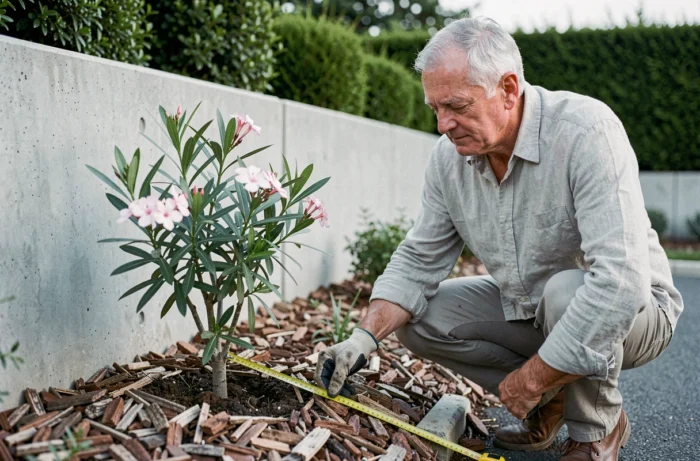
Microclimatic effect of the south-facing wall
A south-facing wall radiates heat at night and blocks cold wind. This microclimate can make ground cultivation possible in regions at the limits for the species.
After a frost episode, seemingly dead stems may sprout from the stump. We advise waiting for vegetative recovery in spring before cutting back.
This thermal protection does not exempt from setback. The warm wall further dries the soil on the south side, which can exacerbate clay shrinkage if the ground is sensitive.
Pruning and volume management to limit underground spread
Regularly pruning the oleander is not just an aesthetic concern. The smaller the leaf mass, the less the shrub needs to extend its root network to obtain water and nutrients.
An oleander trained as a low hedge, kept under one and a half meters, occupies a significantly smaller underground space than a free-standing subject reaching three to four meters. This direct link between aerial volume and root spread is a concrete lever for planting in constrained spaces.
In case of transplantation, the shrub’s root system remains concentrated near the surface. Extracting as many fine roots as possible during uprooting significantly improves the survival rate, provided that the foliage is simultaneously cut back by one third to rebalance the leaf/root ratio.
The oleander remains an accommodating shrub whose fibrous system rarely causes serious structural damage. The determining variable is neither the species nor a standard distance: it is the combination of clay soil and a degraded buried network that transforms a common planting into a source of damage.