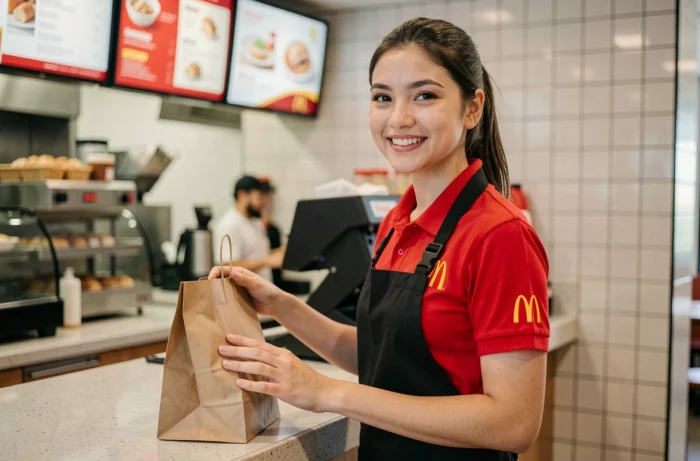
Compensation at McDonald’s is based on a specific conventional framework, that of the collective agreement for fast food (IDCC 1501). Incorrectly applying the HCR (hotels-cafés-restaurants) scales skews any estimation. We regularly observe McDonald’s job postings displaying an hourly rate without specifying the applicable agreement, which complicates the verification of the actual salary for the candidate.
IDCC 1501 and SMIC: the real minimum wage at McDonald’s
McDonald’s France and all fast food chains fall under the collective agreement identified by IDCC 1501. This agreement sets minimums by classification level, but none of these minimums can fall below the current SMIC.
The mechanism is simple: when the SMIC is revalued, the legal floor is immediately imposed, even if the conventional scale has not yet been renegotiated. In practice, hours worked after a revaluation of the SMIC must be paid at the new rate, regardless of the salary payment date. Hours worked in June 2026 at the new rate will be paid on the July payslip, without the need for an amendment to the contract.
This is where we recommend the utmost vigilance. Some McDonald’s job postings mention an hourly rate corresponding to a previous SMIC. A candidate who does not check the salary scale at McDonald’s in relation to the applicable legal minimum risks accepting a compensation that is out of line with the current floor.
Minor salaries at McDonald’s: seniority in the sector matters more than age

Public articles repeat that young people aged 16 or 17 receive a discount on the SMIC. This is partially correct, but the rule has a nuance that is often overlooked.
The discount no longer applies after six months of experience in the professional sector. A minor who has worked six months in another fast food restaurant (not just at McDonald’s) must be paid the full SMIC. The determining criterion is therefore not age at the time of hiring, but cumulative seniority in the fast food sector.
In practice, a 17-year-old hired at McDonald’s after spending a summer at another fast food chain may have already reached this threshold. Failing to check this point amounts to underestimating the salary to which they are entitled.
Discrepancy between displayed salary and actual compensation: key positions
McDonald’s internal scale distinguishes several levels. Here, we focus on the most common positions and the gap between the often-cited gross monthly amount and the reality of the payslip.
Flexible Team Member
The entry-level position is paid at the gross hourly SMIC. For a part-time contract of 24 hours per week (a common format in restaurants), the gross monthly amount is calculated by multiplying the hourly rate by the weekly volume, then by 4.33 weeks. The net received then depends on the employee contribution rate, which varies slightly depending on the company mutual insurance and provident fund.
Manager and Area Manager
The salary of a McDonald’s manager is above the SMIC, with significant differences depending on the level (team manager, area manager, restaurant director). Data shared by employees themselves indicate quite broad ranges. A restaurant manager earns a gross monthly amount significantly higher than that of a team member, but the variable part (performance bonuses, profit-sharing) weighs heavily in the annual total.
The classic trap is to compare a fixed manager salary with the total salary (fixed + variable) of a restaurant director. The two are not comparable without isolating each component.
Benefits and bonuses at McDonald’s: what adds to the gross
Beyond the base salary, several elements complement the effective compensation of a McDonald’s employee:
- Meals in kind: one meal per shift worked, considered a benefit in kind and valued on the payslip. Its flat rate is set by the tax administration.
- Increased pay for night work and holidays, according to the provisions of the IDCC 1501 agreement (and not those of the HCR agreement, which have different rates).
- Mandatory company mutual insurance, with an employer contribution that reduces the cost for the employee but also slightly decreases the net pay compared to a calculation without mutual insurance.
- Profit-sharing and participation, varying according to the restaurant’s results and the franchisee’s policy.
These elements are often absent from online comparators, which limit themselves to the base gross monthly amount.

Career advancement prospects at McDonald’s
Internal promotion remains a structuring axis of McDonald’s HR model. The typical career path follows a logic of levels: team member, trainer, manager, then restaurant director. Each level transition corresponds to a salary revaluation and an expansion of responsibilities (team management, monitoring indicators, franchisee relations).
The transition from team member to manager generally occurs within a few years, with internal training support. The pace depends on the restaurant, the franchisee, and the employee’s availability. Part-time student contracts logically slow down this progression compared to a full-time permanent contract.
For a restaurant director, the compensation often includes a significant variable component linked to the performance of the outlet. This position represents the peak of the operational career path in the restaurant, before a possible transition to head office or multi-site functions.
Before comparing two offers or negotiating a position, verifying the current SMIC on the date of the hours worked and correctly identifying the applicable collective agreement (IDCC 1501, not HCR) are the two reflexes to adopt. A discrepancy of a few cents on the hourly rate, multiplied by hundreds of annual hours, results in a tangible difference in net pay.