Leather has not said its last word. While industrial production floods the shelves and the frantic pace of machines seems to want to dictate its law, French workshops stubbornly insist on slowing down, crafting each piece by hand, refusing the ease of ready-made. Here, tradition does not rhyme with nostalgia, but with demand, discretion, and skill jealously passed down.
The true value of a bag or wallet is not measured in minutes spent on the assembly line, but in attentive gazes, in gestures repeated hundreds of times. From the choice of leather to the last stitch, each step leaves a mark. It is not just the object that benefits: an entire local economy, rare knowledge, and a collective pride emerge strengthened.
French artisanal leather goods, a living heritage that enhances elegance
The French artisanal leather goods need no introduction: it has earned a reputation commensurate with its demands. In these workshops nestled in Versailles, Tarn, Ain, or the Basque Country, each piece passes through the hands of men and women who have learned to look, touch, and feel the leather. Here, patience is passed down, precision is learned, and respect for the craft becomes self-evident.
Forget anonymous leathers and interchangeable collections. Each hide tells a story, that of an animal, a region, a tradition. The French leather goods ensure this uniqueness, supported by the Living Heritage Company label: a recognition awarded to companies that honor made in France, without yielding to the ease of ready-to-produce.
The workshop is anything but a simple factory. It is a melting pot where passion, meticulousness, and sometimes audacity are expressed. French-made leather goods do not merely line up products: they claim a state of mind, embrace a transmission, and focus on innovation to preserve the essential.
Look towards Marcelllin: their approach embodies this movement. Preserving heritage, working with noble materials, supporting the local economy: here, buying a bag means recognizing a sector of excellence and displaying a preference for elegance without compromise.
What makes each piece unique? Between material choices, expert gestures, and creativity
In these workshops, the difference begins with the selection of raw materials. The focus is on full-grain leather, vegetable-tanned to preserve its natural feel and ensure a beautiful patina. This choice, more respectful of the environment, also offers remarkable durability. But innovation does not stop there. The sector experiments, offers recycled leather, alternatives like Apple Skin, grape leather, and even options made from hemp or recycled plastic. These new materials serve an ambition: to combine the beauty of the object with a responsible approach.
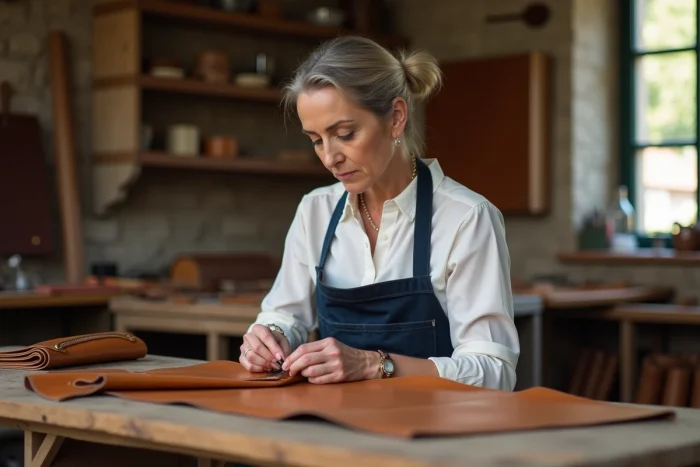
The heart of the craft is execution. Cutting, skiving, hand sewing, finishing: each step reflects a mastery patiently acquired. The eye spots the slightest irregularity, the hand adjusts, corrects, refines. From the grain of the leather to the lining, every detail matters. It is this demand, invisible at first glance, that makes all the difference.
Creativity is never absent. The collections alternate between crossbody bags, travel bags, unisex or personalized models. Each accessory becomes a field of expression: the choice of a pocket, the flexibility of a handle, the color of the thread. By limiting series, playing the personalization card, and being transparent about the origin of materials, French artisanal leather goods refuse to blend into the mass.
Here’s a brief overview of the materials used and their added value:
| Material | Process | Added Value |
|---|---|---|
| Full-grain leather (vegetable tanning) | Traditional and ecological | Durability, natural feel |
| Apple Skin, grape leather | Innovative, vegan | Environmental respect, contemporary aesthetics |
| Recycled leather | Circular | Reduced footprint, uniqueness |
Embracing French craftsmanship: a pleasurable purchase that supports local know-how and the economy
Acquiring a piece of French artisanal leather goods is not trivial. This choice marks a preference for what lasts, what makes sense. Behind each bag, each cardholder, there are artisans who perpetuate a craft, sometimes in the shadows, but always with the same pride. The workshops in Versailles, Tarn, Ain, the Basque Country, or the Charente forests embody this identity and authenticity of “made in France.”
Choosing French-made leather goods means keeping an entire ecosystem alive. These workshops, often family-run, energize their territory. The jobs created are not limited to manufacturing: they also support the leather, dyeing, and specialized distribution sectors. The Living Heritage Company label distinguishes these houses that defend a certain idea of excellence and transparency, without compromise.
Beyond impeccable finishing, this choice is part of a desire for transmission, openness, and authenticity. The value chain extends far beyond the workshop.
Here are some concrete repercussions of artisanal purchases:
- Generation of sustainable local jobs
- Preservation of a tradition passed down through generations
- Assurance of a quality that withstands the test of time
- Contribution to an economy mindful of social and environmental impact
Choosing French artisanal leather goods is betting on an object that transcends trends and years. It is making a wager on uniqueness, durability, and the pleasure of an object that belongs only to oneself, and which, tomorrow, may tell another story, hand in hand.