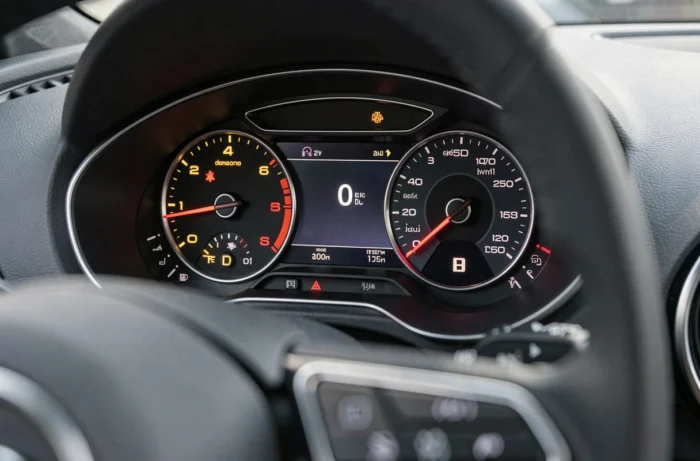
An orange engine-shaped warning light comes on while driving on the motorway, the cruise control switches off at the same time, and the instrument cluster displays a cryptic message. In an Audi A3, this scenario often prompts drivers to pull onto the hard shoulder, even though a simple visit to a workshop in the next few days would be enough.
Understanding how the Audi A3’s dashboard warning lights work helps you tell the difference between a mechanical emergency and an issue that can wait until your next appointment with a mechanic.
Audi A3 driver assistance warning lights: alerts that don’t indicate a breakdown
On newer A3 models equipped with driver assistance features (lane keeping, traffic sign recognition, intelligent speed assistance), unusual icons sometimes appear. These warning lights don’t indicate a mechanical problem: they mean that an assistance feature is unavailable or limited.
The speed warning is a good example. The system relies on optical sign recognition and map data. A sign obscured by vegetation, a poorly marked roadworks zone, or an outdated map can lead to incorrect information being displayed. The warning light then indicates a discrepancy between the detected speed and the actual speed limit.
You can check the list of Audi A3 warning lights to identify each symbol associated with these assistance features. The key point: an active or disabled assistance warning light does not mean you need to stop. Just check that the feature in question isn’t essential for your current driving conditions.

Audi A3 dashboard warning light color codes: red, orange, green
The color system follows a convention shared across the Volkswagen Group (Audi, Seat, Skoda). It works like an inverted traffic light: green means all is well, orange is a warning, and red calls for immediate action.
Green warning light: normal operation
Green warning lights confirm that a system is active. Low-beam headlights on, cruise control engaged, turn signal flashing. No action is needed; you can keep driving.
Orange warning light: arrange a check soon
An orange warning light indicates a fault that doesn’t pose an immediate danger but needs to be diagnosed. The most common one on the A3 is the engine warning light (check engine), often linked to an emissions system issue or a faulty sensor.
You can continue driving with an orange warning light, provided you don’t put the engine under heavy strain. Book a workshop appointment within the next few days.
Red warning light: stop the vehicle
A red warning light means you should stop as soon as possible, in a safe place. The most common situations include:
- Low engine oil pressure (oil can symbol): continuing to drive risks engine failure due to insufficient lubrication. Switch off the engine and have the vehicle towed.
- Excessive engine temperature (thermometer in liquid symbol): the engine is overheating. Stop immediately, open the hood to let it cool, and check the coolant level before restarting.
- Braking system (exclamation mark inside a circle): low brake fluid or a fault in the braking circuit. Do not drive again until you have identified the cause.
- Airbag or seat belt: a fault in the restraint system compromises protection in a collision. The vehicle can still be driven, but passive safety is no longer guaranteed.

Audi A3 engine warning light: the most misunderstood orange warning
The engine warning light (MIL, or Malfunction Indicator Light) causes the most concern. In the A3, it can come on for many different reasons: a worn lambda sensor, a clogged EGR valve, a loose fuel cap, or an occasional misfire.
A steady engine warning light and a flashing one don’t indicate the same level of severity. A steady light points to a fault stored in the control unit, often with no immediate effect on how the car drives. A flashing light indicates active misfires that can damage the catalytic converter. In this case, reduce your speed, avoid hard acceleration, and head to a workshop without delay.
Limp mode (reduced power, limited engine speed) sometimes comes on along with this warning light. The vehicle protects its mechanical components by limiting performance. This isn’t an additional fault; it’s a protective measure programmed into the control unit.
OBD diagnostics and Audi A3 warning lights: what you can check yourself
The OBD2 port, located under the dashboard on the driver’s side, lets you read the fault codes associated with illuminated warning lights. With a basic OBD reader or a compatible app, you can access the codes stored in the engine control unit.
This reading doesn’t replace a full workshop diagnosis, but it can point you in the right direction. For example, a P0420 code indicates insufficient catalytic converter efficiency. A code related to the intake system (P0171, P0172) suggests an imbalanced air-fuel mixture.
Clearing a fault code without fixing the cause solves nothing: the warning light will come back during the next drive cycle if the problem persists. OBD readings are for understanding the issue, not hiding it.
On plug-in hybrid A3 models (e-tron), some specific codes relate to the high-voltage system and require specialist attention. Never work on the high-voltage system without the proper training and equipment.
Audi A3 dashboard warning lights cover a wide range, from simple informational reminders to serious mechanical alerts. Color is the first way to assess them. Whether the light is steady or flashing helps refine the diagnosis. And the OBD port provides the exact code a mechanic needs to carry out repairs without guesswork.