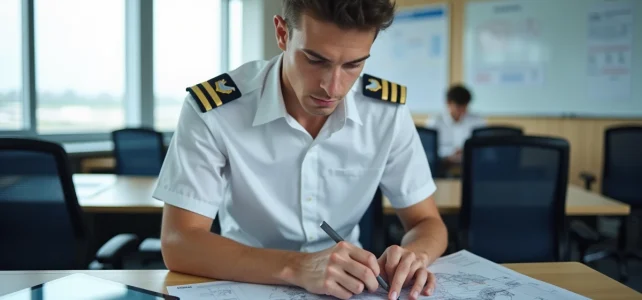
The Air France cadet program combines a rigorous medical screening, an increasing demand for digital skills, and the shock of transitioning to online training. The stories of young cadets depict a journey that is much more abrupt than the official storytelling.
Medical requirements in Air France pilot training: the invisible filter
Class 1 medical fitness remains the least documented barrier in the cadet selection process. Candidates readily discuss psychotechnical tests or group interviews, but rarely what happens in an aeronautical expertise office.
Recently admitted cadets report training interruptions of several months related to additional assessments, particularly cardiological and psychiatric ones. A benign heart murmur in general medicine can trigger a series of examinations that freeze the candidate’s progress. The cadet then remains in limbo, with no guarantee of resuming.
Several recent journeys, like those compiled in the testimonials on Professeur Debbie, confirm this gap between the candidate’s perception and the reality of the process. The medical aspect is not just an administrative stamp: it is a journey within the journey, with its own timelines and uncertainties.
A temporary unfitness can occur during training, not just at entry. A cadet already in flight phase can be put on hold for an unexpected ophthalmological or ENT check. The psychological burden of this sword of Damocles is not mentioned in any promotional vlog.
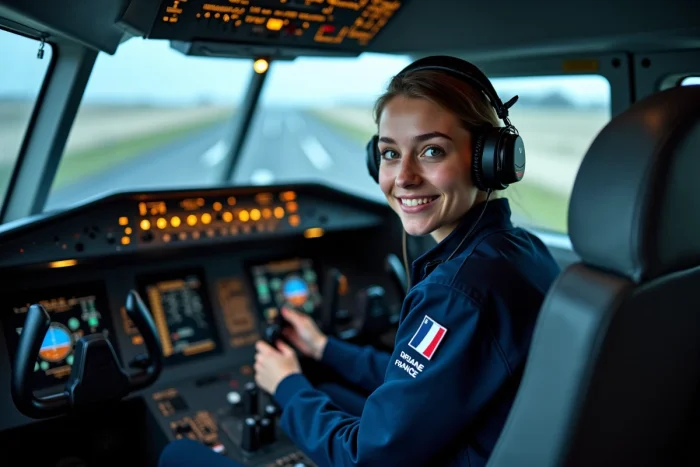
Air France cadet selection: the typical profile has changed
Since the post-COVID recruitment resumption, the selection has significantly tightened around two axes that previous candidates did not mention with the same emphasis.
Aeronautical English and digital skills
The level of English is now a discriminating factor earlier in the process than before the pandemic. Group tests now include situational assessments where the switch from French to English is immediate. A technically solid candidate but hesitant in English phraseology no longer passes this stage.
The digital dimension has also gained importance. The tests evaluate the ability to manage multiple streams of information simultaneously on screen, a direct reflection of the evolution of glass cockpits. Cadets entering the program today present a significantly more versatile profile than their predecessors.
What motivation interviews really assess
The interviews do not seek a declared passion for aviation. We observe that Air France juries probe the candidate’s ability to:
- Provide critical feedback on a personal mistake, without minimizing or dramatizing
- Integrate into a strict hierarchical framework while expressing a technical disagreement constructively
- Manage the uncertainty of a training schedule that can change overnight
These behavioral skills weigh as much as the results in psychomotor tests. A brilliant candidate in hand-eye coordination but rigid in communication regularly fails at this stage.
First flights online after cadet training: the real baptism of fire
Online content almost always stops at the issuance of the license. The transition from cadet to OPL (line pilot officer) within the company, however, constitutes the most demanding moment of the journey.
The transition from simulator to commercial line imposes a radical change of pace. In training, each flight is debriefed, and every mistake is a learning opportunity. Online, the captain expects smooth execution from the very first rotations. The right to hesitate disappears.
Young OPLs from cadet programs describe a specific operational pressure: punctuality constraints, managing turbulent passengers relayed by the cabin chief, and degraded weather conditions at airports they have only flown over in theoretical briefings. The gap between the protected environment of school and the reality of commercial flight remains under-documented.
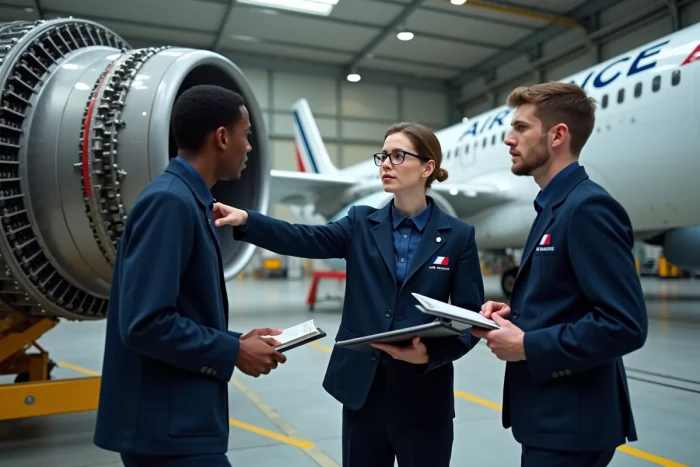
Fatigue and adaptation to the rhythm of rotations
Jet lag is not the main issue. What destabilizes young co-pilots is the accumulation of short rotations on European sectors with sometimes tight regulatory rest times. The body adapts, but the first months test both physical endurance and technical competence.
We recommend that future cadets do not idealize this phase. Air France training prepares technically, but conditioning to the operational rhythm only happens through direct experience. No simulator training replicates the cumulative fatigue of a week of consecutive early morning rotations.
Cost and financial commitment of the Air France cadet program
The cadet program differs from traditional ab initio training by its economic model. Air France covers a significant portion of the training cost in exchange for a multi-year service commitment within the company. This mechanism reduces the financial barrier to entry but creates a contractual obligation that candidates sometimes underestimate.
Private ab initio training, such as integrated ATPL in an accredited school, represents a much heavier personal investment. The cadet program remains one of the most financially accessible pathways to becoming a line pilot in France, provided one accepts the trade-off: you do not choose your base, your type of aircraft, or your pace of progression during the first years.
- The cadet selection is free, unlike some foreign programs that charge for entrance tests
- The cadet receives a salary during training, which distinguishes them from a traditional student pilot
- The post-training commitment clause limits mobility to other companies for a defined contractual duration
The Air France cadet program trains competent pilots, but the surrounding narrative would benefit from incorporating the gray areas: medical uncertainties, pressure in the first months online, and binding contractual commitments. Knowing these realities before applying allows for building a stronger application and approaching each step with the right expectations.